
How We Worked with Music on Projects for Yandex, S7, MTS, Borealis and AstraZeneca

Music in a video can catch your attention, develop an idea, change how you see a product, give a brand character or carry part of the story.
Over the years, we’ve developed a few principles that guide much of our work. They help us find sounds that support the director’s vision, shape the viewer’s experience and give the brand a clearer voice.
Here are five projects that show how we put them into practice.
The opening seconds
The beginning and end of a video are important emotional moments. The opening draws the viewer in. The ending leaves them with a feeling that lasts beyond the final frame.
The strongest moment doesn’t have to come in the very first second. But the opening should give you a reason to keep watching, whether through curiosity or the mood it creates.
The Yandex Browser video opens with a digital big bang. We created a sound effect for that moment to give it scale and an immediate emotional impact. Pyotr Glants, the Russian dubbing voice of Deadpool, adds to the effect.
The soundtrack centres on a rhythmic track with female vocal ad-libs and the phrase “make it rock”. We wanted a bold, energetic sound that matched the video.
The music changes its pattern at certain points to follow the action, then returns to the main motif. That recurring idea holds the piece together and carries the viewer through it.
A different way to see a familiar product
Finding a fresh angle on something familiar is a large part of creative work. Music is no different. Choosing a genre and gathering references only gets you so far. You also need to consider different ways of seeing the product and what meaning the music could add to the video.
Even an everyday product can support a distinctive visual idea. The idea has to help people see it differently without making it harder to understand.
For Borealis, we wanted music that supported the video’s individual point of view. One early idea was to reinterpret Mahler’s St Anthony of Padua’s Sermon to the Fish. There was an interesting connection to the brand, but the result felt too pretentious and drew too much attention to itself.
We settled on electronic ambient music that gradually builds, with quiet, almost ASMR-like sound design in places. The sound made the video feel more sensory. Together, the music and sound design supported its aesthetic and helped present a familiar product category in a different light.
Having a point of view
Commercial work comes with a brief, but we believe a composer or music designer should still bring an individual perspective to it.
A director or art director often sets the overall vision. In that structure, it’s easy for music to become a support service and for the composer’s role to narrow to carrying out someone else’s ideas.
We see proposing our own ideas as part of the job. Sometimes the composer has the clearest sense of where current becomes merely fashionable, bold becomes crass, or emotional becomes excessive.
Our AstraZeneca project is a good example. We were asked to create music for the opening of a corporate event and an awards ceremony. It needed a sense of occasion, as well as a contemporary sound and plenty of energy.
An obvious starting point is to add a modern beat to an orchestra. But a contemporary sound doesn’t come down to a genre or whatever happens to be trending. You need to understand the emotion each musical style brings.
A symphony orchestra can work very well with hip-hop. Take it towards trap or drill, though, and the result can feel much younger, harder and more aggressive. That wasn’t the mood this project needed.
We chose a different route. The piece begins with a symphony orchestra, gradually moves into a lighter hip-hop section, then returns to the orchestral sound. That progression gave it momentum while keeping the sense of occasion, without chasing a trend for its own sake.
Music with a life of its own
Music written for a video can have its own character and development. Even with a specific job to do, it should be worth listening to.
For us, a good track works in the video and holds your attention on its own. You want to hear the rest of it, remember it or look it up afterwards.
That was our aim for MTS Verse: music that sounded like an artist’s release, with a life beyond the edit. It’s a standard we set ourselves, even when the brief doesn’t ask for it.
The project called for an energetic, contemporary sound for a fast-moving video about metaverses. We wanted the music to reflect the newness of the product and an industry that was still unfamiliar to a broad audience.
The bass sound was one of the key decisions. We wanted something you might hear on Spotify from an experimental electronic act. A male vocal repeating “We keep running faster and faster” gave the track more of its own identity.
Usually, questions about the track turn up in the comments after a video goes live. This time, the client was the one asking.
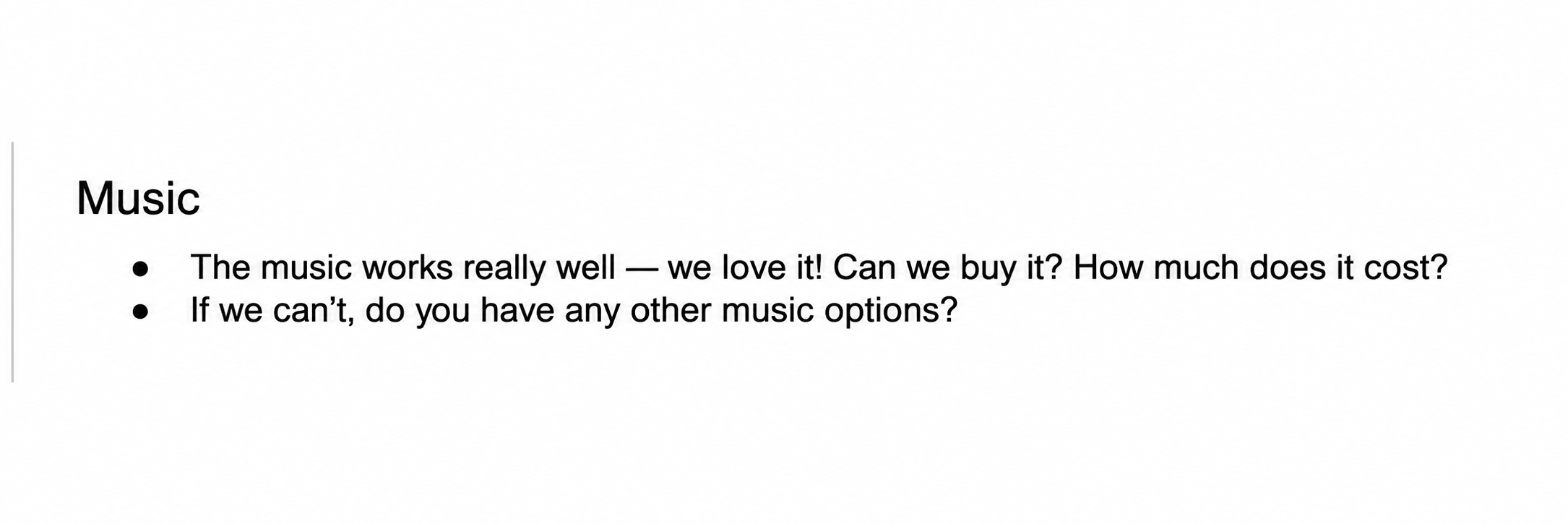
That kind of musical identity matters to the brand too. A track people want to hear outside the video gives the brand another way to express its character through sound.
Leaving room for sound design
Music can shape the overall mood, but individual sounds sometimes carry the idea. Sound design can make a visual metaphor feel physical, giving movement to air, texture to light and continuity to a sequence of cuts.
In S7’s “Svetlaya polosa” video, the same idea appears as an aircraft’s trail, a shaft of sunlight, sea foam and moving snow. The Russian title refers both to a bright stripe and to a good stretch in life.
Our task was to connect these different spaces through sound, helping viewers feel that connection before they consciously read the metaphor.
Sound design played an important part. Air, movement, natural textures and transitions between scenes gave the sequence continuity and made its visual idea more tangible.
Where we start
Each of these projects called for a different musical solution. The starting point was the same: what does sound need to do in this particular story?
That question comes before choosing a genre, following a reference or deciding what sounds contemporary. Sometimes music carries the idea. Sometimes sound design does more of the work. Usually, we need both.
We use those choices to develop the story, support the director’s vision and give the brand a more distinctive, memorable voice.